
AWS Bedrock AI Observability installation


Let AI instrument your LLM calls for you
Skip the manual setup — run this in your project and the wizard installs the SDK and wires up AI Observability for you.

Contents
- 1
Install dependencies
RequiredInstall the OpenTelemetry SDK, OTLP exporter, and the AWS SDK instrumentation for your language.
- 2
Set up the OpenTelemetry exporter
RequiredConfigure the OpenTelemetry SDK to export traces to PostHog's OTLP ingestion endpoint. PostHog converts
gen_ai.*spans into$ai_generationevents automatically. - 3
Call Bedrock
RequiredMake Bedrock API calls as normal. The instrumentation automatically captures
gen_ai.*spans for Converse, ConverseStream, InvokeModel, and InvokeModelWithResponseStream operations.Supported modelsThe instrumentation emits
gen_ai.*spans for Amazon Titan, Amazon Nova, and Anthropic Claude models. Tool call instrumentation is available for Amazon Nova and Anthropic Claude 3+.Note: If you want to capture LLM events anonymously, omit the
posthog_distinct_id. See our docs on anonymous vs identified events to learn more.You can expect captured
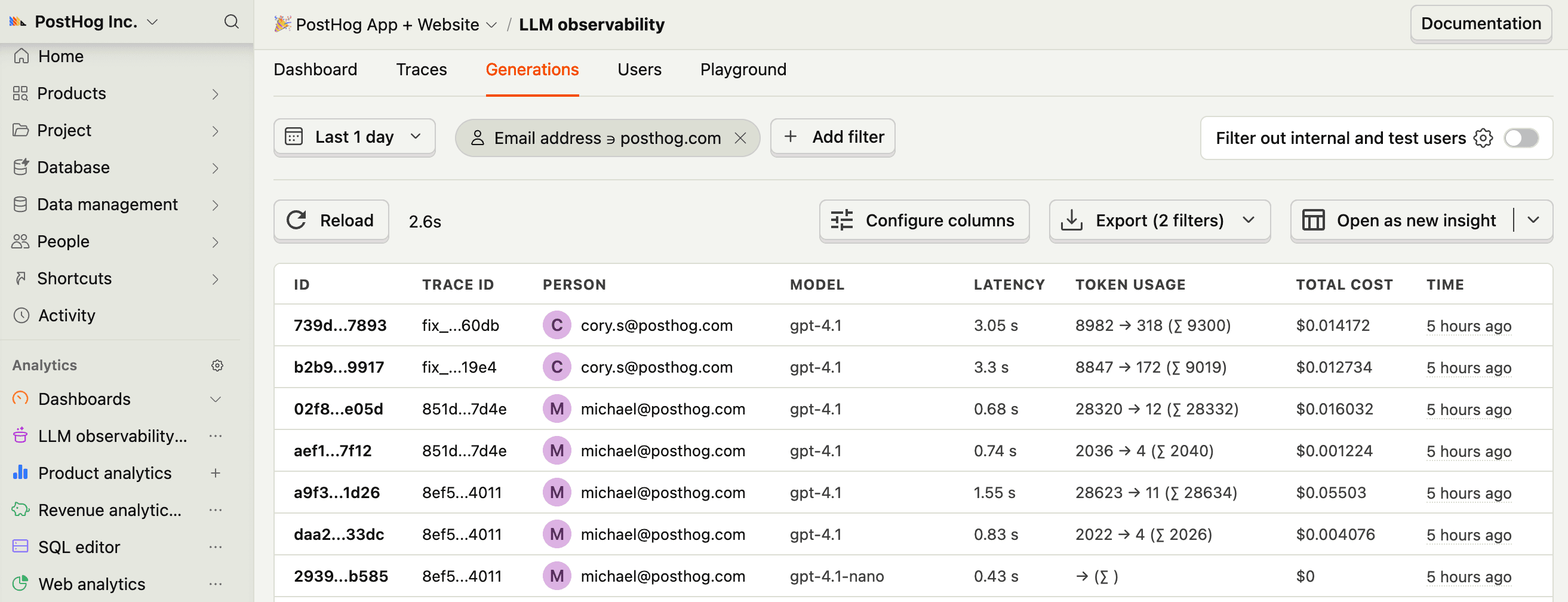
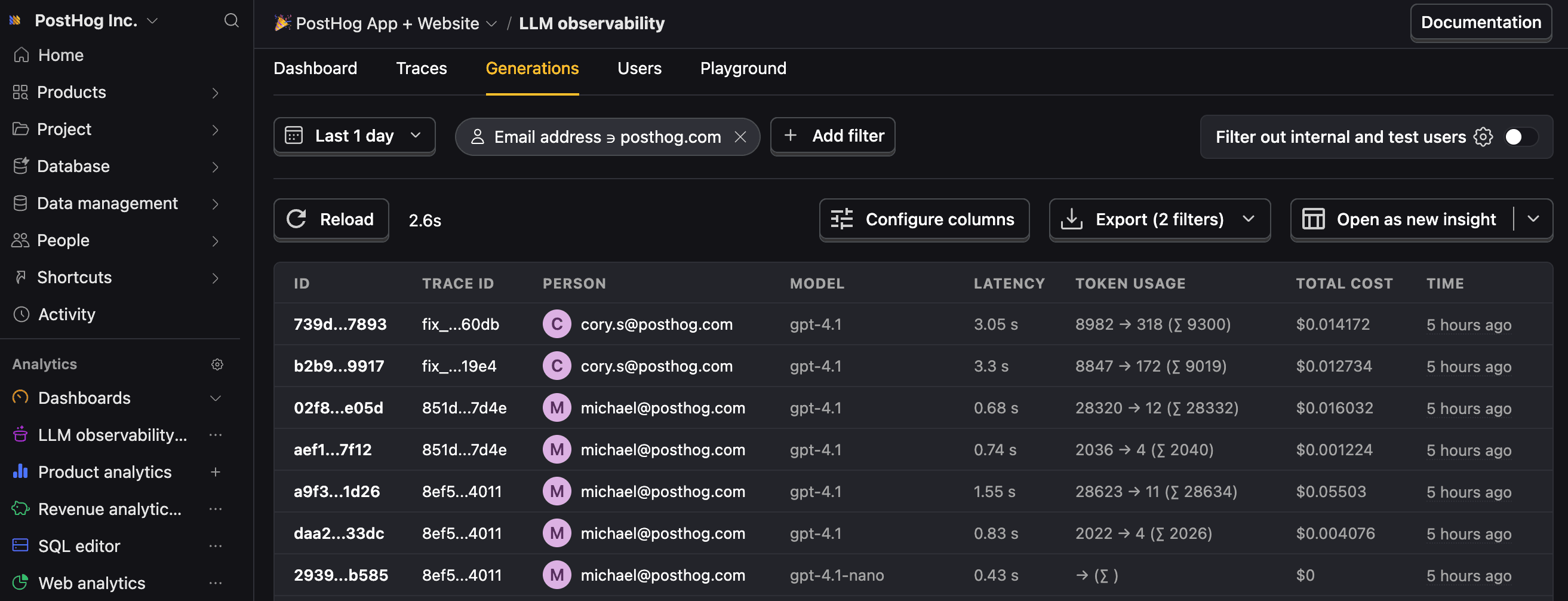
$ai_generationevents to have the following properties:Property Description $ai_modelThe specific model, like gpt-5-miniorclaude-4-sonnet$ai_latencyThe latency of the LLM call in seconds $ai_time_to_first_tokenTime to first token in seconds (streaming only) $ai_toolsTools and functions available to the LLM $ai_inputList of messages sent to the LLM $ai_input_tokensThe number of tokens in the input (often found in response.usage) $ai_output_choicesList of response choices from the LLM $ai_output_tokensThe number of tokens in the output (often found in response.usage)$ai_total_cost_usdThe total cost in USD (input + output) [...] See full list of properties - 4
Group traces into sessions
OptionalPostHog groups traces into a session when they share an
$ai_session_id. Set it if your product has multi-turn conversations, so the Sessions tab can reconstruct them. Workloads that finish in a single trace, like batch jobs or one-shot generation, do not need it.The instrumentation creates the LLM span for you, so there is no call to pass the session ID to. Add a span processor that sets the
$ai_session_idattribute as each span starts. PostHog forwards span attributes it does not recognize onto the event, so the value arrives as the$ai_session_idproperty.On Node, add
new SessionIdSpanProcessor()to thespanProcessorsarray of theNodeSDKyou configured earlier, next toPostHogSpanProcessor. Keep the rest of that setup as it is, includinginstrumentationsand thesdk.start()call.If a process only ever handles one session, set
$ai_session_idas a resource attribute next toservice.nameinstead. Resource attributes apply to every span the process emits, so that only works when the process and the session are the same thing. - 5
Next steps
RecommendedNow that you're capturing AI conversations, continue with the resources below to learn what else AI Observability enables within the PostHog platform.
Resource Description Basics Learn the basics of how LLM calls become events in PostHog. Generations Read about the $ai_generationevent and its properties.Traces Explore the trace hierarchy and how to use it to debug LLM calls. Spans Review spans and their role in representing individual operations. Anaylze LLM performance Learn how to create dashboards to analyze LLM performance.